

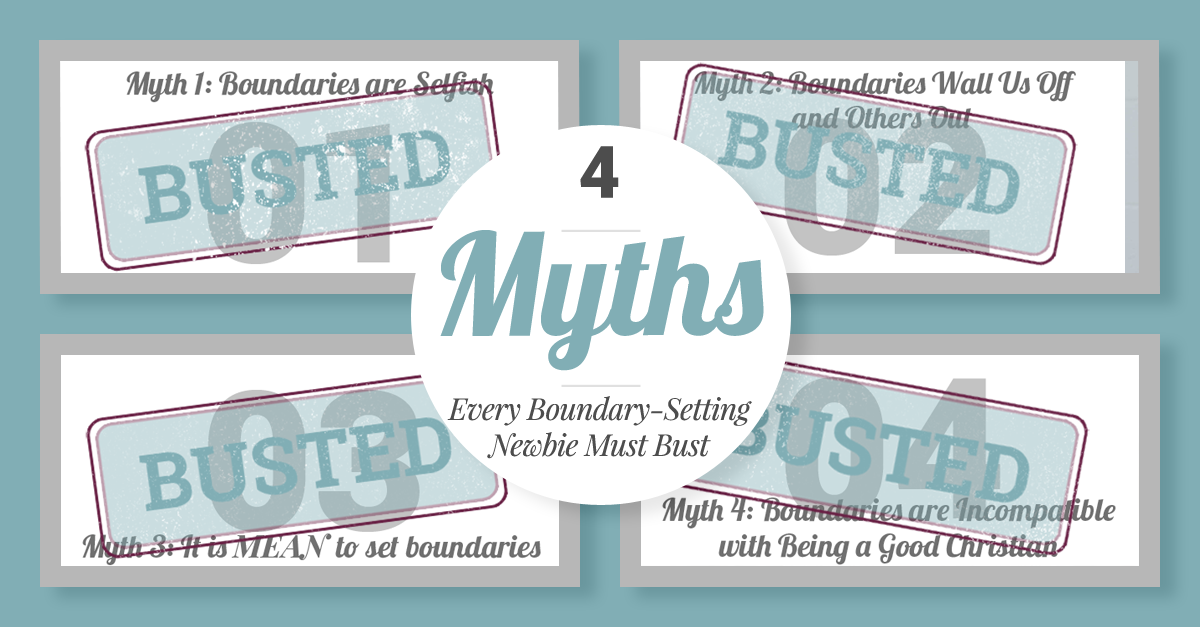
In my years of learning about and teaching biblical boundary-setting, I’ve run across four widely-held misconceptions about boundaries. Until these myths are busted and the truth is revealed, people resist the subject of boundary setting. They get wrapped up in false guilt because they misunderstand the nature of godly limits.
[featured-image link=”https://mirm.agapesoulspa.com/4-myths/” single_newwindow=”false”]
Important: I’m not a therapist, psychologist, or pastor. So, I can’t offer you that kind of expert counsel. What I can offer you is the fruit of twenty plus years of study, practice, trial and error that empowered me to develop and maintain healthy boundaries and more fulfilling relationships.
So, let’s bust these four illusions.
Let’s look at each misconception and test it against God’s truth and grace.
Myth 1: Boundaries are Selfish
Do you feel a tug of guilt or self-consciousness when you consider saying no (even when you know you need to). If so, you probably hold to this faulty fancy.
If you think boundaries are just a disguise for getting whatever you want at the expense of others, you’ve got the wrong idea about this biblical skill.
Jesus was the most unselfish person in history. And he was the master at setting healthy boundaries. So, clearly godly boundary-setting is not selfish.
Actually, selfishness is a symptom of a deficiency of good boundaries. A selfish person is focused on their own needs and wants at the expense of others.
A person with legitimate limits is “us” focused. They want the best for themselves AND others.
Myth 2: Boundaries Wall Us Off and Others Out
If you figure “boundary” is just a synonym for “wall” or “barrier” you’ve bought into this particular mistaken assumption. Let me explain the difference.
A wall or barrier prevents relationship. Actions, words, beliefs, and so forth that isolate us and prevent us from loving others and being loved by others are NOT godly boundaries. They are rather a lack of life-giving limits.
Biblically-based boundaries facilitate genuine relationships with other people in our lives. True intimacy is not possible if we have walls where we should have boundaries. And authentic connection isn’t possible if we have no sense of proper limits.
Myth 3: It is MEAN to set boundaries.
Okay, be honest. You don’t want to feel mean or have anyone else think of you as an ungenerous person, right? And you fear saying no to someone’s request will have that result.
I’ve got some great news for you. When you understand what a boundary actually communicates, you’ll no longer have to worry about being a meanie.
Guilt and fear will dissipate once you master the boundary basics.
Like God (who designed and modeled limit-setting, by the way), we followers of Christ want the best for others. While those with a lack of boundaries take that to mean one must be a doormat for irresponsible people, godly boundary-setters guide their expression of compassion with a healthy sense of personal responsibility and wisdom.
We are willing to sacrifice when appropriate to lift a crushing burden off someone unable to shoulder it. God loves lavishly and sets limits regularly. The two concepts compliment one another rather than contradict each other.
Myth 4: Boundaries are Incompatible with Being a Good Christian
This one is very similar in principle to the previous three. We know Jesus calls us to live sacrificially for others. Yet he also had clear and strong terms as to what he accepted in his presence, when and how he made himself available to others, and other solid limit-setting beliefs and behaviors.
Jesus had an exceptional sense of self while at the same time showing immense compassion, kindness, and love toward the people in his life. He even loved his enemies.
Clearly following Christ’s example is not incompatible with this relational skill set we call boundary-setting.
Verdict: Myths Busted!
I hope this little myth-busting session helps set your mind at rest so you can embrace and practice healthy limit-setting.
Stay Tuned for BOUNDARY BASICS #2
Why is it so easy for us to believe these myths? Well, the answer to that is what we explore in BOUNDARY BASICS #2. So stay tuned to your inbox.
Recent Comments