

Have you ever felt pressured to compromise your beliefs, values, behavior and/or the nature of your relationships? Then you’ve experienced the type of boundary problem Paul addressed in his letter to the Galatian church.
[featured-image link=”https://mirm.agapesoulspa.com/load-versus-burden” link_single=”inherit” single_newwindow=”false”]
Important: I’m not a therapist, psychologist, or pastor. So, I can’t offer you that kind of expert counsel. What I can offer you is the fruit of twenty plus years of study, practice, trial and error that empowered me to develop and maintain healthy boundaries and more fulfilling relationships.
The church in Galatia was comprised of a mix of Gentiles and Jewish converts to the Christian faith. This was not a problem since they knew the truth of the gospel and related to God and each other based on their belief that they were saved by what Jesus had done rather than what they had done. In Christ, they were unified.
However, after Paul departed, some misinformed visitors arrived from Jerusalem.
These guys caused all kinds of havoc in the spiritual and relational health of the Galatian church by pressuring the Christians to adopt and adhere to the Jewish traditions and beliefs. And the bullying and manipulation worked.
The Jewish Christians pressured their Gentile brothers and sisters to observe Jewish rituals or lose fellowship with them.
When word of this reached Paul he was appalled! And rightly so. Paul wrote to restore these believers to a correct understanding of the gospel.
And while you might not see it at first, the problem Paul addressed was a boundary problem as much as it was a theological one.
As Creator, God alone has the authority to determine how his creation, including humanity, functions and relates to him as well as the consequences for disregarding the established terms.
He provides clear guidance about how he designed us to live and relate to him, others, and the whole of creation. God leaves up to us whether we choose his way or ours. However, with the choice comes the natural consequences of that decision.
You can decide you don’t like the law of gravity and don’t want to be bound by it. But if you step off a cliff, you’re going to fall. And the result of your fall is not God’s fault, it is yours for ignoring reality.

Within this framework, God gave humans dominion over his Creation. While we must exercise that stewardship within the terms of his revealed limits, he does give us responsibility for specific aspects of our lives.
Knowing what we are accountable for is key to avoiding boundary problems such as that experienced by the Galatian church.
God endows each person with responsibility for their own mental, physical, emotional and spiritual dimensions of themselves.
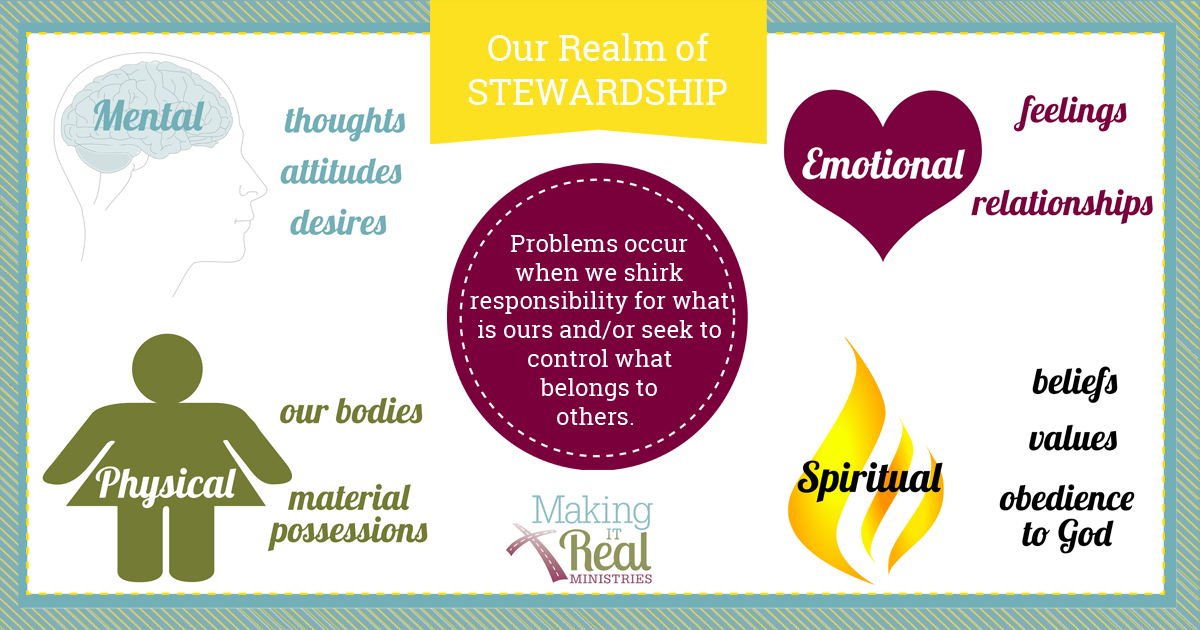
God holds us individually responsible for our thoughts, attitudes, desires and beliefs.
Our feelings and how we give and receive love and relational support are also within our realm of stewardship.
Likewise, we have responsibility for our bodies and the material possessions with which God has blessed us.
And God gives us the authority and responsibility to choose how we will relate to him and what we will believe about him.
Why the Galatians Had Boundary Problems
Are you beginning to understand why the theological problem in Galatia was rooted in a boundary problem?
The false teachers failed to acknowledge God’s authority to set the terms of the relationship between God and humanity. God provided Jesus as the means of salvation. These men insisted on observance of the law as the means of salvation.
As for their part of the boundary problem, the Galatians abdicated their realm of stewardship. They gave the power to determine their beliefs, attitudes, and manner of relating to God and one another over to these false teachers.
In typical Paul fashion, his letter is a reasoned, yet passionate, argument for salvation by faith in Christ. After reminding these confused and manipulated Christians of the true gospel, he begins to close his letter with the following words which address the underlying boundary issues:
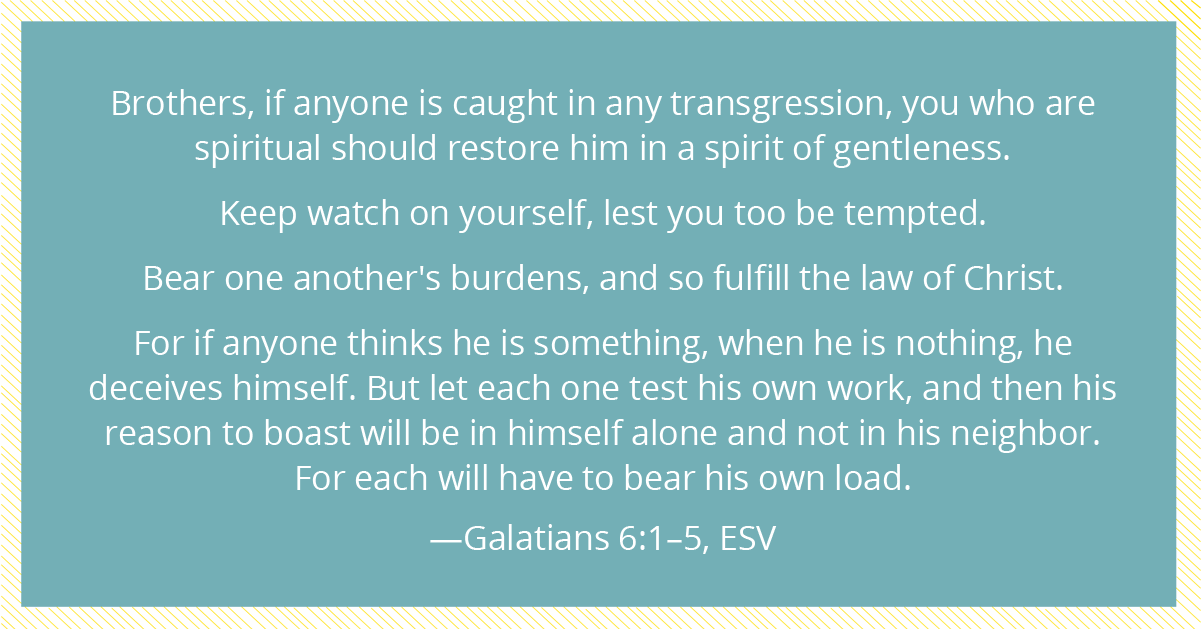
Let’s unpack what Paul’s original recipients would have heard in those words.
Key Distinction: Burden versus Load
The term Paul used for a load was the Greek term for a ship’s capacity. The boat’s load was what it was built to carry safely and effectively. The word translated as “burden” was the the weight which would overload and sink a ship.
Here’s a little graphic to illustrate the difference. (Can you tell I’ve been doing lots of laundry lately…)

Paul admonished the Galatians to exercise appropriate responsibility over their load (their realm of stewardship).
In effect, Paul is saying to his readers: “If you think you are able to save yourself, you’re lost. Think for yourself. Did you receive the Holy Spirit because you observed the law perfectly or because Christ fulfilled the law and you accepted what he did on your behalf?”
Rather than correcting the false teachers’ transgressions against God’s authority, the Galatians adopted the error. They abdicated responsibility for their mental, emotional, physical and spiritual response.
Helping one another shoulder circumstances beyond our capacity to bear on our own is part of being a good steward of our relationships.
Patience and grace with one another’s faults must not preclude restoring someone who is lost in their sin. Allowing them to drown in their sin is not a loving response.
Instead of knuckling under to the false teachers’ pressure, Paul admonished the Galatians to confront the error in a spirit of gentleness. Bearing one another’s burdens is not pretending there is not a problem but a willingness to address the problem while seeking the best for the one caught up in it.
Do You Have a Boundary Problem?
You can’t address what you don’t assess. Knowing what comprises our load, or realm of stewardship, is the key to recognizing the presence of a boundary problem and formulating a godly solution.
Reflect on what God put within your realm of stewardship. Get clear on what part of the problem is a result of you not taking responsibility for what is rightly yours to carry. Are you trying to shift aspects of your load onto someone else? Or, is someone trying to hijack an aspect of your load? Make sure each is carrying his or her own load.
On the other hand, is there a situation which threatens to overwhelm or capsize someone in your realm of influence. Are you appropriately coming alongside them to help shoulder the burden?
Do you have a legitimate burden too big for you to bear on your own? If so, are you willing to ask your brothers and sisters in Christ to come along side you and help you? Being willing to help and be helped when appropriate is a sign of relational health.
Stay tuned for BOUNDARY BASICS #4
Now you know the basics about how to distinguish between a load and a burden. This is how you diagnose the type of boundary problem you have. What are the different types of boundary problems? You’ll learn that in [BOUNDARY BASICS #4]. So, watch your email inbox for that post!
Recent Comments